Blog
How Businesses Can Replace Multiple Marketing Tools With One Connected Platform (CES)
October 22, 2026 / 10+ minute read / By Muneeza Shahid
Digital Marketing, General
Blog
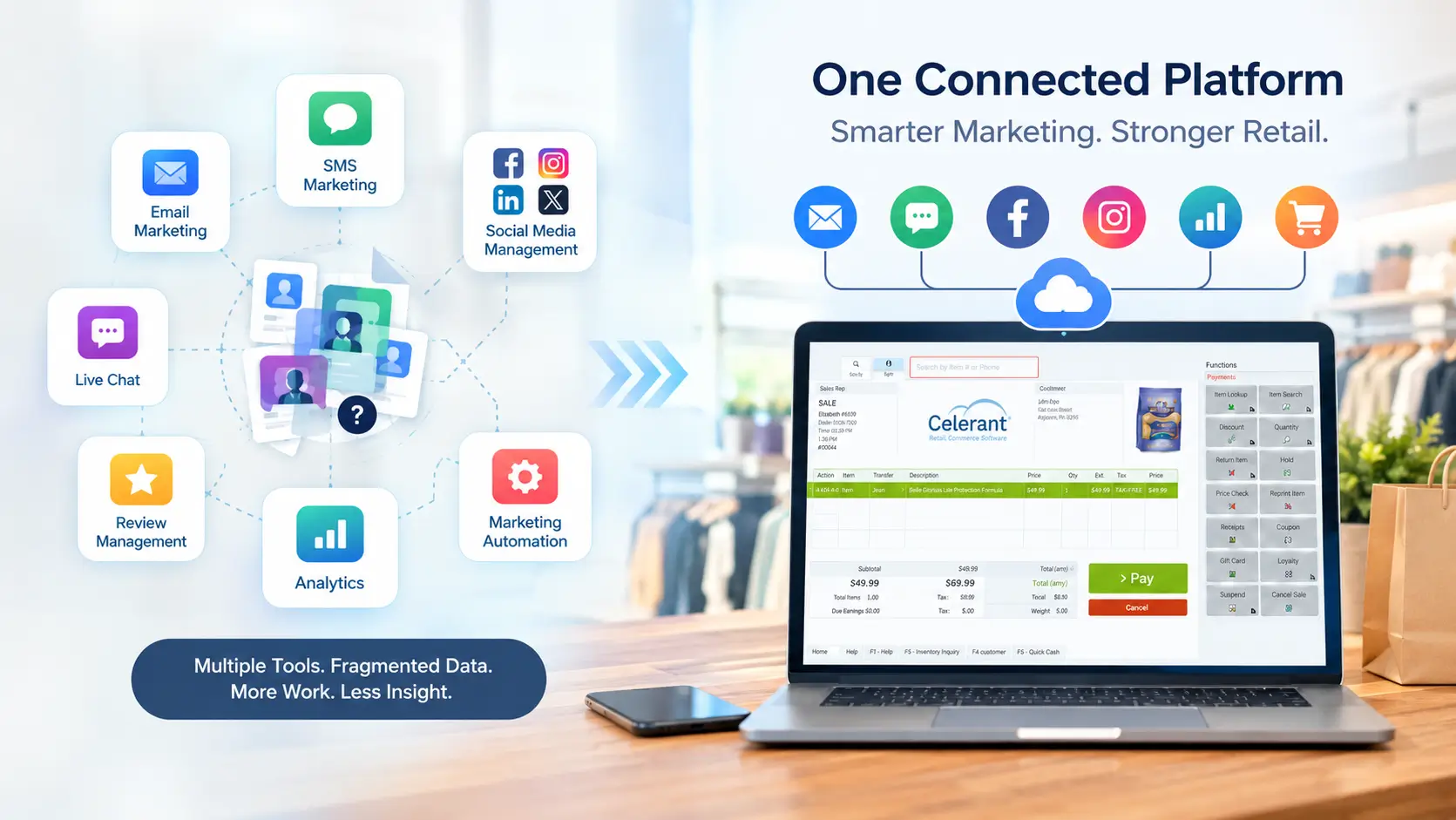
Marketing is a multi-faceted operation today, with retailers using separate platforms to manage different marketing activities. These can include email campaigns, SMS, social media, live chat, customer reviews, and analytics. While every tool comes with its own features, managing all of them becomes a real challenge when a business expands.
This can lead to fragmented customer data across different systems, resulting in more administrative work for the marketing team. It also hurts campaign reporting, as retailers struggle to identify which marketing activities are driving engagement and conversions.
Rather than using separate marketing tools for each activity, businesses can switch to AI-powered connected marketing platforms that bring these activities into a single platform.
In this guide, we’ll explore the pros and cons of using independent marketing platforms and how a connected system can provide an effective solution for modern retailers.
Most startups begin with one marketing channel, such as email marketing. As the business grows, they may add SMS marketing to target customers on mobile devices. Likewise, for social media, they may also introduce a social media management tool. Over time, they may add live chat, review management, marketing automation, and analytics tools to their technology stack.
Though most of these specialist tools offer unique features, the main problem occurs when they operate independently.
For example, a retailer may know that a customer placed an order through its POS system, but the marketing platform only knows that the same customer opened an email and can’t connect that engagement to the customer’s purchase.
In short, when the data isn’t connected, businesses end up with fragmented information that could be very useful if everything is connected. Over time, managing multiple marketing tools can become increasingly difficult, leading to additional administrative work and ineffective decision-making.

When marketing tools aren’t connected, customer data can become scattered across different platforms. This makes it difficult for retailers to build a complete view of each customer. Teams also spend more time transferring data manually between multiple systems and comparing reports from different sources.
This lack of connectivity leads to inconsistent customer experiences, duplicated work, lost opportunities, and inaccurate campaign reporting. Some of the issues that retailers face are shared below:
Customer information exists in multiple places, including the POS, eCommerce platform, email marketing system, CRM, and loyalty programmes. When the systems are disconnected, useful data, such as shoppers’ purchase history, marketing engagement, and loyalty activity, remain separated across different platforms, making it harder to understand the complete customer journey. Marketers then need to manually combine the information or work with incomplete customer profiles.
Disconnected platforms also increase administrative work for marketing teams. Employees may need to switch between different dashboards, import customer lists, verify data, and maintain multiple integrations.
That time could instead be spent designing campaigns, analyzing customer behavior, and improving the customer experience.
Successful marketing campaigns depend on reaching the right customers. When the systems are disconnected, every marketing channel may have its own version of a customer’s information. For example, an email platform may have a customer’s engagement history, while the POS contains their purchase history and the loyalty system tracks their rewards activity.
This makes it difficult to create meaningful segments and deliver personalized campaigns to the right audience.
Different marketing platforms provide different metrics. An email platform may report open and click rates, a social media platform reports engagement, and website analytics tracks page views, bounce rates, and conversions. However, businesses need a complete view of these metrics to understand how marketing activities contribute to revenue.
This is only possible when businesses connect marketing activity with transaction data to get a clear picture of campaign performance.

A connected marketing platform brings customer engagement functions together and connects them with the business data marketers need. Depending on the system, it can include:
The important part is not to have all these details together in one dashboard but to connect the underlying data. For example, retailers can use a customer’s purchase to trigger follow-up campaigns, identify a loyalty milestone, or create an audience for a future promotion. This connection between marketing and retail data can have a measurable performance impact.
According to Deloitte omnichannel marketing campaign reports, retailers connecting POS and loyalty data with digital marketing have achieved up to 15% lower cost per purchase and nearly 20% higher incremental store revenue.
Connecting retail data helps businesses plan campaigns based on the customer’s overall relationship with the brand.
Businesses don’t need to replace every marketing tool. The right approach to consolidation depends on factors such as the company’s size, existing technology, industry, and marketing objectives. However, some areas that must be consolidated include:
Email and SMS are managed separately despite both being used for customer communication. Bringing them into a connected marketing environment can help businesses to coordinate campaigns, manage customer segments, and use the underlying customer information.
Social media and online reviews are important customer engagement points. Managing these activities from a single dashboard helps businesses to monitor engagement and respond appropriately.
Marketing automation can help consolidate repetitive workflows and reduce manual tasks. For example, businesses may create workflows to respond to particular customer actions such as an abandoned cart, a loyalty milestone, a completed purchase, or a period of inactivity. Automation helps marketers manage continuous workflows instead of manually monitoring customer actions.
Customer data is one of the most important areas to consolidate. When marketing data is combined with transactional and customer information, businesses can create more personalized campaigns based on customers’ relationship with the brand.
At the end of the day, businesses need to know which tools genuinely add value and which ones create duplicate workflows. A specialist platform offering advanced functionality is still the right choice over a broader marketing tool. However, a standalone tool that performs overlapping functions and constant data transfers can be consolidated to simplify marketing operations.
Before replacing or consolidating marketing technology, businesses should evaluate the following factors:
The Number of Platforms: How many standalone tools does your marketing team use on a weekly or monthly basis?
Duplicate Data: Is the customer data duplicated in multiple systems?
Manual Processes: Is your team regularly engaged in manual administrative work such as exporting, importing, or cleaning customer lists?
Integration Requirements: Is your system compatible with integration, or are you dependent on third-party integrations?
Reporting: Can you track marketing engagement against real sales?
Total Cost: What is the total cost of all your marketing subscriptions and integrations?
Team Efficiency: How much time is consumed managing administrative work rather than marketing?
If several of these areas are creating operational friction, a connected marketing platform may be worth considering.
Businesses must look beyond features when selecting a unified marketing platform. The more important question is whether those features can share relevant customer and retail data.
In addition to a connected marketing platform, retailers can also benefit a great deal if the different systems such as POS, eCommerce, inventory, and loyalty data are integrated. This helps to plan campaigns based on customer profiles, loyalty activity, transactions, and inventory.

The goal of consolidating marketing technology isn’t simply to have fewer tools. It is to build a more connected system where customer data, marketing activity, and retail information come together to support better decision-making and business outcomes.
Celerant’s Customer Engagement Suite brings multiple marketing platforms – emails, SMS, social media, live chats, and reputation management into a single platform. It is also directly connected to POS, eCommerce, and customer data; retailers can use the real customer engagement data and purchase history to create more personalized campaigns and better understand which marketing activities are actually driving sales.
1. What are the benefits of replacing multiple marketing tools with one platform?
A connected marketing platform minimizes manual data entry, eliminates duplicate workflows, synchronizes customer information, and makes tracking marketing performance across channels really simple.
2. How does a connected marketing platform improve customer personalization?
Connecting marketing activity with data such as purchase history, loyalty programmes and customer behavior helps retailers to create more personalized campaigns based on customer engagement. Celerant’s CES connects marketing tools with POS, inventory, eCommerce and customer data.
3. Do businesses need to replace every marketing tool they currently use?
No. Businesses must identify the tools that provide unique value and the ones that create redundant and duplicate data. Retailers can also continue to use specialist tools with unique features that aren’t covered by a connected platform.
4. Can a connected marketing platform automate campaigns?
Absolutely. Connected platforms are AI-powered and can automate marketing campaigns based on customer interactions such as purchases, loyalty activity, abandoned carts, and periods of inactivity. This helps to improve customer engagement without manually managing every campaign.