Blog
What is Automated Order Routing in Omnichannel Retails
October 19, 2026 / 10+ minute read / By Muneeza Shahid
General, Retail

Blog
Customers want a seamless shopping experience in omnichannel retail. They want their orders to arrive on time, without a scratch, and at a reasonable price. Meeting these expectations can be challenging for omnichannel retailers, particularly when they need to coordinate inventory and fulfillment across physical stores, warehouses, distribution centers, and eCommerce platforms.
An online order can be fulfilled from a nearby store, central warehouse, or some other location based on inventory availability, customer proximity, shipping charges, and fulfilment capacity. Managing these decisions manually can become time-consuming and increase the risk of fulfillment errors.
This is where automated order routing can help. In this guide, we will cover:
In this blog, we’ll cover:
Automated order routing is the process of assigning customer orders to the most suitable fulfillment centre. It is based on multiple factors such as inventory availability, customer location, shipping costs, fulfillment capacity, and business rules.
For example, a customer in New York orders a pair of running shoes online. The product is available at the retailer’s New York store, Chicago store, and a distribution center in Ohio. Instead of sending the order to the distribution center, the automated order management system evaluates the inventory, distance, shipping requirements, and fulfillment rules. If the New York store fulfills the order efficiently, the system will direct it there. This enables retailers to better use inventory across their network.

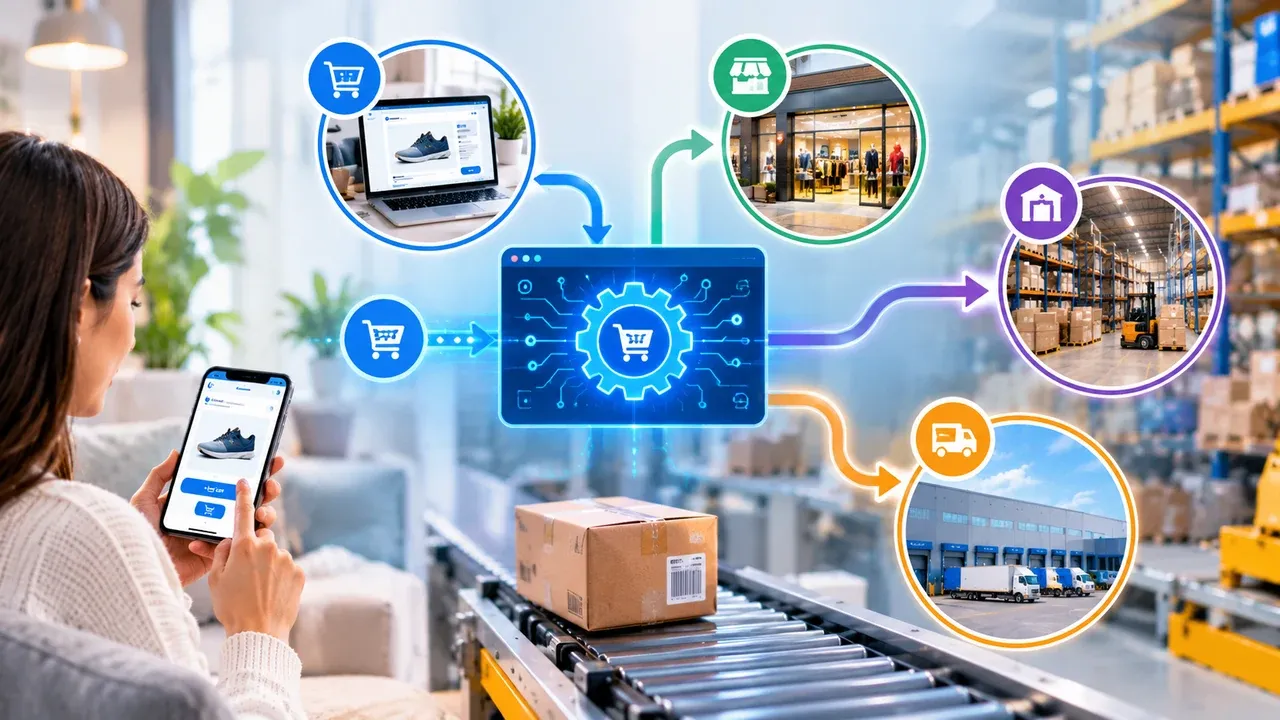
Automated order routing connects retail systems from eCommerce, POS solutions, inventory management, order management, warehouses, and fulfillment locations. The process consists of five steps, such as:
The process starts when a customer places an order through an eCommerce website, marketplace, mobile channel, or some other connected sales channel. The order management system grabs information such as the products ordered, delivery address, shipping method, and fulfillment requirements.
The system checks for the available inventory across the different sales channels, including stores, warehouses, and fulfillment locations. Accurate inventory data here plays a crucial role in delivering the right order, as outdated information can route the order to a location that doesn’t have the product available.
The system is automated to determine the appropriate fulfillment location based on predefined rules. These include everything such as:
Retailers need to identify factors that are most suitable to their business.
Once the system finds the suitable location, the order is assigned automatically. The store, warehouse, and fulfillment centers can then start packing and shipping the order.
Once the order is routed and fulfilled, the inventory and order information is updated in the system. This ensures inventory visibility and accuracy for both the customers and employees.
Omnichannel retail gives a lot of shopping flexibility to customers, but at the same time it also comes with operational complexity. Retailers have to ensure inventory visibility across all the sales channels – physical stores, an eCommerce site, or marketplaces. Without this, effective order routing wouldn’t be possible, resulting in fulfillment delays, unnecessary shipping costs, and inventory gaps.
Automated order routing directs customer orders to the right inventory and fulfilment location based on availability. Here are some of the reasons why it is important for omnichannel retail:
Rather than treating physical store and warehouse inventory as completely separate pools, automated routing helps retailers to use inventory across their network. This helps to support fulfillment models such as ship-from-store; buy online; pick up in store (BOPIS); and store-to-store fulfillment.
Routing an order to the location nearest to the customer helps reduce fulfillment and delivery times. For example, if a product is available at a nearby store, shipping it from that particular location is more efficient than sending it from a distribution center that’s far off.
Shipping every eCommerce order from a central warehouse isn’t always the right option even pricing-wise. Automated routing considers location and shipping requirements when selecting a fulfillment point. Curtailing unnecessary shipping distances lowers fulfillment costs while effectively using the retailer’s inventory network.
As retailers expand, assigning orders manually becomes difficult. Employees have to check inventory, contact stores, review shipping requirements, and decide the location of order fulfillment. Automation cuts the entire workload and helps employees focus on exceptions and higher-value tasks.
Order routing also requires reliable inventory information. When POS, eCommerce, inventory, and order management systems are synchronized, retailers gain a clear view of the stock levels and the most appropriate location for dispatch. This helps minimize situations where a product appears available online but can’t be fulfilled in reality.
The main difference between automated order routing and manual order routing is how fulfillment decisions are made. In manual order routing, employees review orders and identify the fulfillment location. This works for retailers with limited locations and order volumes but becomes difficult to manage as they expand.
In automated order routing, software has predefined fulfillment rules to evaluate inventory and allocate orders.
| Manual Order Routing | Automated Order Routing |
|---|---|
| Employees allocate orders | Software allocates orders |
| Becomes time-consuming as operations expand | Able to handle large volume of orders |
| Increases risk of manual errors | Has a predefined set of business rules |
| Has a fragmented inventory | Has centralized inventory data |
| Difficult to scale | Supports expansion across multiple locations |
| More operational intervention | Employees focus on exceptions |
Automation still requires human monitoring. It creates a consistent workflow for routing processes but makes room for employee intervention if needed.

Automated order routing helps, but only when the systems support it. Retailers should know if their POS solution, eCommerce platform, inventory management, and order management system are all connected. When all the key retail systems are synchronized, retailers can access accurate inventory visibility across the business. This is critical for automation, or it would route orders to the wrong fulfillment centers.
Retailers also need a set of predefined routing rules prioritizing metrics such as the closest store, lowest shipping costs, and higher inventory levels. There must also be room for exceptions such as out-of-stock products, split orders, oversized items, and orders needing special care.

Effective routing is all about accurate and connected retail data for omnichannel retailers. Celerant’s unified retail management solution connects key retail operations from POS, eCommerce, inventory management, order management, to accounting and marketplace integrations. This helps retailers gain real-time inventory visibility for successful order fulfillment across different sales channels through automation.
The goal is not just to automate a process but to create a connected retail environment where customer orders, inventory, eCommerce, and fulfillment operations work together.
What is automated order routing in retail?
Automated order routing uses software and preset business rules to determine the store, warehouse, and fulfillment location for fulfilling a customer order.
What factors does automated order routing consider?
It considers multiple factors, including inventory availability, customer location, shipping costs, delivery requirements, and fulfillment capacity at suitable fulfillment locations.
Does automated order routing work with ship-from-store?
Absolutely. Automated order routing can check if a store is an appropriate location for fulfilling an eCommerce order to support ship-from-store models.
How does order routing improve omnichannel retail?
It connects online orders with inventory and fulfillment locations across the entire network. This improves inventory usage, reduces manual processes, and enables faster fulfillment.
What is required for effective automated order routing?
Effective automated order routing needs accurate inventory data, connected retail systems, clear fulfillment rules, and reliable order management processes.