Blog
Best Retail CRM and Loyalty Platforms Compared
November 10, 2026 / 10+ minute read / By Muneeza Shahid
CRM, General, Retail
Blog
A retail CRM helps businesses use customer data to deliver a smooth shopping experience, build customer loyalty, and encourage repeat sales. However, some platforms have a different take on customer relationship management. Some connect CRM capabilities with core retail systems, including point of sale (POS), eCommerce, inventory, and loyalty, whereas others focus primarily on customer data, marketing automation, and retention.
There is no single best retail CRM for every business. The right choice depends on a retailer’s requirements, existing technology, and the range of operations they want to manage through one system.
This guide compares seven retail CRMs and loyalty platforms – Celerant, Salesforce, HubSpot, Klaviyo, Yotpo, Lightspeed, and Shopify POS across customer data, POS, loyalty, eCommerce, marketing, and customer segmentation features.
Quick answer: Celerant is worth considering for retailers looking to connect POS, eCommerce, customer management, loyalty, and marketing within a retail management platform. Lightspeed also combines retail POS with customer management and loyalty capabilities, although available features depend on the product and plan. Salesforce offers a broader enterprise retail ecosystem, while HubSpot and Klaviyo focus on CRM, customer data, and marketing. Yotpo specialises in loyalty and retention, whereas Shopify POS connects online and in-store commerce with customer data and supports loyalty through third-party apps.
Before comparing platforms, retailers should consider how effectively each system connects customer data to support customer relationships and business decisions. Important features to consider include:
Retailers also need to understand the difference between native functionality and third-party integrations. A platform may support a capability without providing it as part of its core product. This distinction is important when comparing features, implementation requirements, and overall costs.
| Platform | Main strength | Retail POS | CRM/customer data | Loyalty | eCommerce | Marketing |
|---|---|---|---|---|---|---|
| Celerant | Connected retail, CRM and engagement | Native | Native | Built-in | Native | CES add-on |
| Salesforce | Enterprise retail CRM ecosystem | Separate POS product | Native CRM | Separate Loyalty product | Commerce Cloud | Marketing Cloud |
| HubSpot | CRM and marketing automation | Third-party integrations | Native CRM | Third-party integrations | Commerce tools and integrations | Marketing Hub |
| Klaviyo | Customer data and lifecycle marketing | Integrations | Customer data platform | Third-party integrations | eCommerce integrations | Core capability |
| Yotpo | Loyalty, referrals and retention | Integrations | Loyalty-related customer data | Core capability | eCommerce integrations | Loyalty-focused engagement |
| Lightspeed | Retail POS, loyalty and marketing | Native | Native customer profiles | Product/module-dependent | Lightspeed eCom | Additional marketing modules |
| Shopify POS | eCommerce and omnichannel POS | Native | Native customer profiles | Third-party apps | Native | Shopify marketing tools |
Note: Feature availability depends on the product, subscription, region, and integration. Some platforms offer capabilities through separate products or third-party apps rather than including them in their core POS or CRM offering.
Best for: Retailers interested in a connected POS, eCommerce, CRM, loyalty, and customer engagement platform
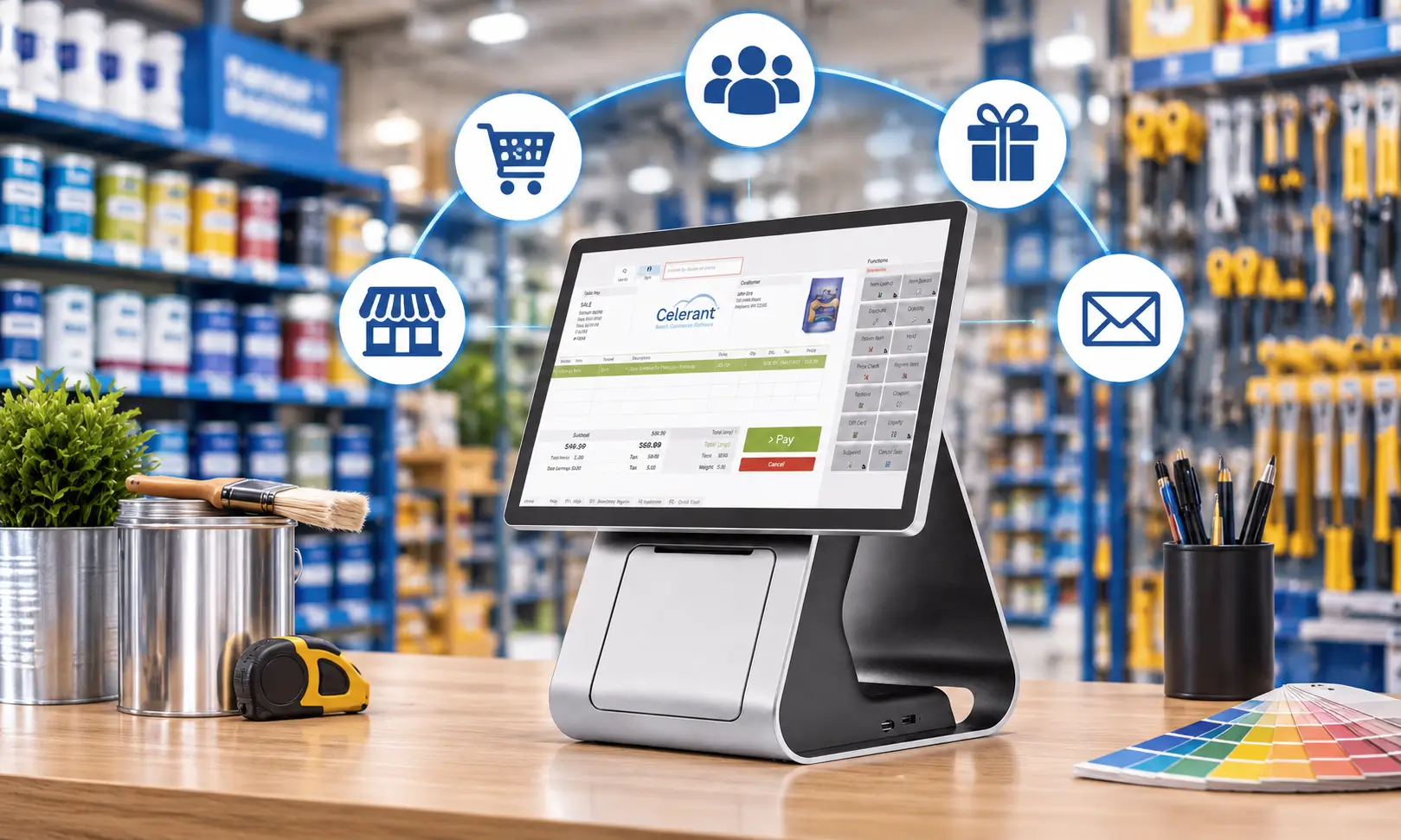
Celerant has a retail-first approach to CRM. Its retail CRM solution connects customer information with key retail functions, including point-of-sale (POS), mobile apps, in-store sales, eCommerce and online marketplaces. This allows retailers to use customer data and purchase history to personalize customer engagement.
Its loyalty capabilities include points-based rewards, spend- or visit-based programmes, tiered loyalty and cross-channel reward redemption. Celerant also helps retailers run membership programmes with recurring benefits and exclusive pricing options.
Related: Turning Shoppers into Loyal Buyers
With its Customer Engagement Suite (CES), retailers can use customer data to inform marketing activities. CES connects customer profiles, transactions, inventory, and loyalty activity with customer engagement tools, including email, SMS, social media, live chat, reviews, and marketing automation.
CES is an additional solution, and SMS is an optional add-on. This gives retailers a way to use information from their retail operations to inform customer communications and engagement.
For example, a retailer can use purchase history and loyalty activity to identify customer segments and create more relevant campaigns, rather than sending the same promotion to every customer.
Retailers can learn more about Celerant’s Customer Engagement Suite and how it brings customer data and marketing activities together.
Retailers interested in connecting customer engagement with their wider store operations can also explore Celerant’s retail POS system and eCommerce solution.
Key consideration: Celerant is primarily a retail management software provider, relevant for retailers who want CRM and loyalty connected across their retail operations. Retailers should confirm which modules and engagement features are included in their proposed configuration.
Best for: Large retailers looking for an enterprise CRM and retail technology ecosystem
Salesforce offers a dedicated retail portfolio covering customer engagement, commerce, marketing, service, loyalty, and point of sale. Its retail capabilities span multiple products and integrations, including POS, eCommerce, inventory management, and loyalty management, so the exact functionality depends on the solution a retailer implements.
Its loyalty management platform can connect with POS systems through APIs to support activities such as enrolling loyalty members, retrieving member profiles, managing vouchers, and accumulating and redeeming points.
Salesforce also offers a dedicated Point of Sale product, alongside separate products such as Loyalty Management, Commerce Cloud, and Marketing Cloud. Retailers can combine these products to support different parts of the customer journey and retail operation.
Key consideration: Salesforce provides a broad enterprise technology ecosystem rather than an all-in-one retail management system. Retailers may need to assess which Salesforce products, editions, and integrations best fit their requirements.
Best for: CRM, customer relationships, and marketing automation
HubSpot’s CRM gives centralized access to contact records, customer information, and interactions. Its contact management tools help businesses maintain customer records and connect CRM information with other applications through integrations.
HubSpot’s CRM also supports marketing automation using CRM data to personalize communications.
Retailers can use HubSpot to manage customer and prospect information, segment contacts, and coordinate marketing activities. However, retail-specific capabilities such as POS transactions, inventory management, and loyalty programmes generally require integrations with other platforms.
Key consideration: HubSpot isn’t a direct competitor of a retail management system with built-in POS and inventory management. Retailers using HubSpot have to check how their existing POS, eCommerce, and loyalty systems integrate with HubSpot. They should also review subscription requirements, as access to advanced automation and other features varies by plan.
Best for: Customer segmentation, email/SMS marketing and lifecycle engagement
Klaviyo primarily focuses on customer data and marketing automation. Its customer profile combines website activity, purchases, and marketing engagement, whereas its segmentation feature supports audiences based on customer behavior and data. This makes it useful for retailers interested in creating targeted customer journeys and lifecycle campaigns.
Klaviyo can also connect with supported eCommerce and POS systems to bring customer and purchase information into its marketing platform. Retailers can use this data to create segments and automate communications based on customer activity.
However, POS, inventory, and loyalty functionality depends on integrations with the retailer’s wider technology stack.
Key consideration: Retailers must figure out how customer and transaction data is transferred between Klaviyo and their retail systems, including POS, eCommerce, and loyalty rewards. Klaviyo is primarily a customer data and marketing platform, not a complete retail management or POS system.
Best for: Loyalty, referrals, and customer retention
Yotpo prioritizes customer loyalty and retention for retailers. Its loyalty and referrals product supports loyalty tiers, customer engagement, and rewards. The documentation ties loyalty tiers to milestones such as spending or client referrals, with rewards and benefits available at different levels.
It integrates with various eCommerce platforms including Shopify Plus, BigCommerce, Adobe Commerce (Magento), Salesforce Commerce Cloud, and custom platforms. Available integrations and functionality can vary by platform and implementation.
Yotpo also offers other eCommerce marketing solutions, including reviews and user-generated content tools, but its Loyalty & Referrals product is focused on rewards, referrals, and customer retention.
Key consideration: Yotpo is primarily a loyalty and retention platform rather than a retail POS or retail management system. Retailers that need customer records, inventory management, and in-store transaction processing will need to assess how Yotpo connects with their other retail systems.
Best for: Retailers wanting POS, customer management, loyalty, and marketing in a retail platform
Lightspeed offers multiple overlapping features with Celerant. Its retail POS platform includes customer management capabilities, while additional loyalty and marketing functionality may be available through specific products, plans, or integrations.
The retail features include customer profiles and, depending on the product and configuration, loyalty tools such as points-based rewards, customer segmentation, and marketing campaigns.
Lightspeed also offers Advanced Loyalty and Marketing powered by Marsello for supported products. Depending on the setup, these capabilities can include loyalty tiers, email and SMS marketing, referrals, customer segmentation, and automated campaigns.
Key consideration: Retailers should define clear requirements before evaluating specific Lightspeed products, because functionality varies across its ecosystem. They should confirm whether the loyalty and marketing tools they need are included in their plan or require an additional module or integration.
Best for: Retailers already using the Shopify commerce ecosystem
Shopify POS connects physical and online platforms through Shopify’s broader platform. Its POS features include customer profiles, lifetime spend, purchase history, customer notes, tags, and marketing preferences. It also allows retailers to view in-store and online order history together.
Shopify also supports customer segmentation on factors including purchase history, location, and spending habits, in addition to email and social media marketing.
For loyalty programmes, retailers can use third-party apps that integrate with Shopify to offer rewards, points, referrals, and other customer incentives.
Key consideration: Shopify POS is a good fit for retailers already using Shopify for commerce, but if they want advanced loyalty, it’s best to evaluate loyalty apps for their features, compatibility, and additional costs before choosing one.


No single retail CRM and loyalty platform fits every retailer. The best solution depends on a retailer’s requirements and the combination of customer data, retail operations, loyalty, and marketing features it needs.
Celerant is worth evaluating when a retailer wants CRM and loyalty connected to POS, eCommerce, and broader retail operations. Lightspeed is another retail-focused option, although its available loyalty and marketing features depend on the products and modules selected. Salesforce is suitable for a broader enterprise ecosystem.
HubSpot and Klaviyo are well-suited to retailers prioritizing CRM and customer engagement features, while Yotpo offers loyalty and customer retention. Shopify POS is a strong option for retailers already using the Shopify ecosystem.
Before making a final decision, retailers should compare each platform against their POS and eCommerce systems, loyalty requirements, and customer engagement goals. They should also consider integration requirements and whether essential features are built in or require third-party tools.
Retailers looking to develop or improve their loyalty strategy can also explore Celerant’s Loyalty Programs 101 eBook.
Want to see how customer data, POS, eCommerce, and engagement tools can work together across retail operations?
There is no single best CRM for a retail business, which means retailers have to compare different metrics, including customer profiles, purchase history, POS, eCommerce, segmentation, loyalty, and marketing features.
Celerant and Lightspeed are options for retailers looking for customer management alongside retail POS capabilities. However, the available loyalty and marketing features differ by platform and configuration. Salesforce, HubSpot, Klaviyo, and Yotpo each have their own strengths and weaknesses as far as customer relationship and engagement processes are concerned.
Retail CRM is designed to work with retail-centric information, including transactions, products, purchase history, stores, and loyalty activity. A generic CRM focuses primarily on contacts, sales activities, and communications. Salesforce is an enterprise platform offering dedicated retail capabilities in addition to broad CRM functionality.
Some retail CRM platforms do include loyalty programmes, and some don’t. Celerant offers loyalty capabilities as part of its retail platform. Lightspeed also offers loyalty functionality, although availability depends on the product and configuration. However, Yotpo primarily focuses on loyalty and referrals. HubSpot, Shopify POS, and Klaviyo typically rely on integrations or third-party tools for loyalty functionality.
Absolutely. Most modern retail CRM platforms connect customer and transaction information across physical and online channels. Celerant, Salesforce, and Shopify offer commerce-related capabilities within their broader platforms. However, the architecture and actual integration vary. HubSpot, Klaviyo, and Yotpo can also connect with eCommerce platforms, but their roles and the data they manage differ.
Retailers should evaluate customer profiles, purchase history, POS and eCommerce connectivity, rewards, reporting, marketing, and integrations when choosing CRM and loyalty software. They should also understand whether each platform offers a standalone capability or depends on a third-party integration to ensure a specific feature.