Blog
Beyond Omnichannel: Why Unified Commerce is the Next Big Retail Shift
November 17, 2026 / 10+ minute read / By Muneeza Shahid
General, Point of Sale, Retail

Blog
Retailers use several platforms to deliver omnichannel shopping experiences. But providing multiple shopping channels doesn’t always translate into smooth business operations. That’s because many retailers still lack connected retail functionality.
For example, some retailers don’t have connected inventory systems, which can lead to duplicate customer records because employees have to switch between different systems to process orders or access sales information. These operational gaps create challenges for customers and retailers alike.
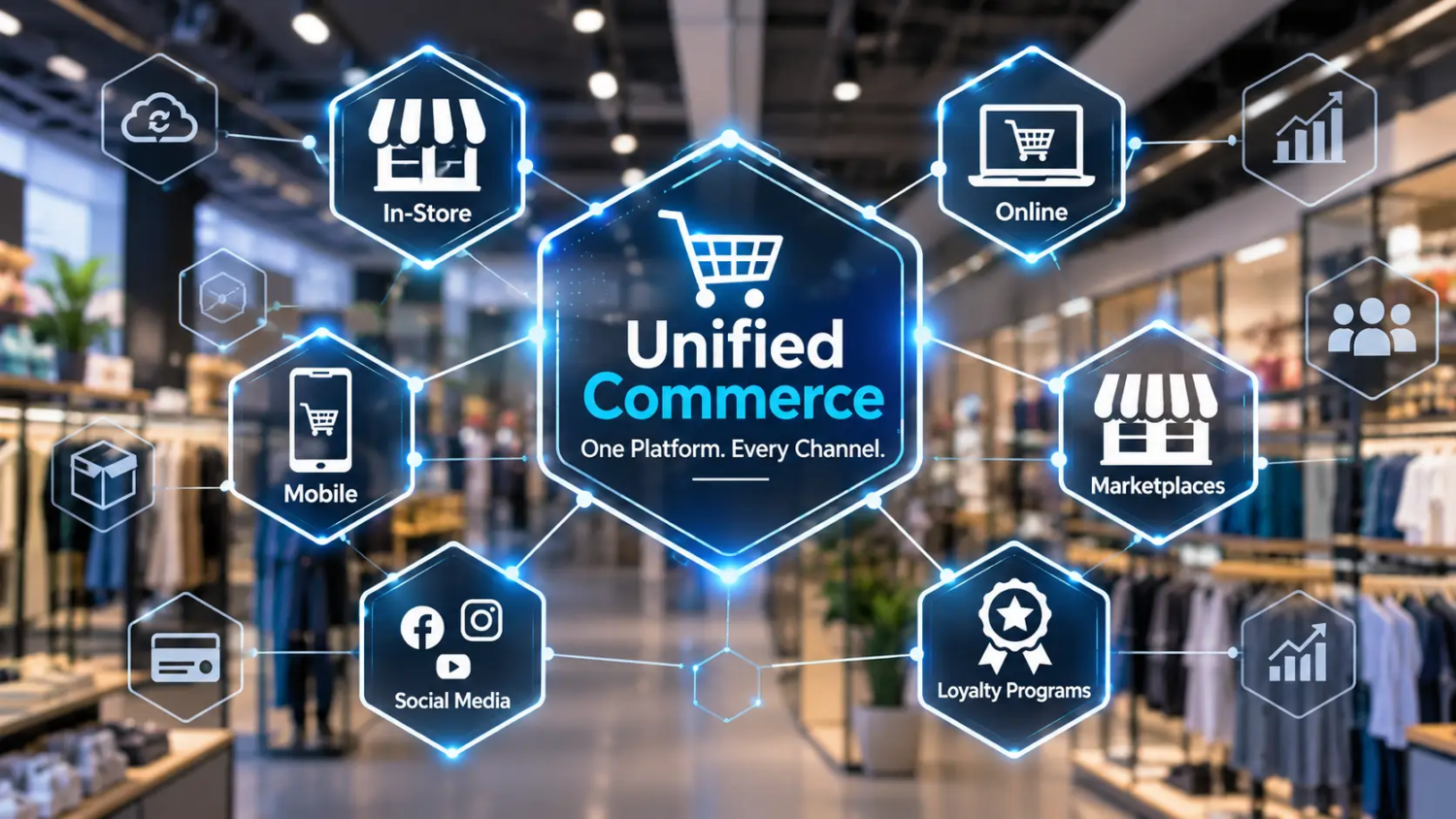
This is where unified commerce comes into play. As the name suggests, it brings customer information, inventory, sales, and order management together through a connected technology platform. This helps retailers work with shared business information to ensure a consistent customer experience.
Managing multiple shopping channels is difficult even when retailers have connected their eCommerce websites with their POS systems. Their teams may still need to manage separate customer databases, inventory records, and order management processes. Customers can shop across different channels, but employees may have to reconcile information manually. This makes it important for retailers to address the gaps between their sales channels and business operations.
According to the 2025 Global Digital Shopping Index by PYMNTS Intelligence and Visa Acceptance Solutions, 48% of global shoppers used a mobile phone during their most recent retail purchase. This demonstrates how digital interactions influence shopping, even when customers complete their purchases in physical stores.
As shopping journeys increasingly move between digital and physical touchpoints, retailers need to connect essential operations, including inventory, product information, pricing, and customer data. This is where unified commerce becomes important.
Omnichannel retail and unified commerce are closely related, but they don’t mean the same thing. Omnichannel retail connects different shopping channels, allowing customers to move between them with minimal friction. Unified commerce takes this further by connecting the retail operations and data that support those experiences.
For example, consider a retailer with three physical stores and an eCommerce website. With an omnichannel setup, customers can buy products online and collect them in-store. However, the retailer may still use separate systems to manage inventory updates, customer records, and order information.
With unified commerce, these activities, including inventory, POS transactions, customer information, and order updates, operate through connected workflows. Employees can access online orders, inventory information reflects transactions across different locations, and customer purchase histories are available across supported channels.
Here is a comparison between omnichannel retail and unified commerce:
| Comparison | Omnichannel retail | Unified commerce |
|---|---|---|
| Primary focus | Connected customer experience | Connected customer experience and business operations |
| System architecture | Multiple connected systems and integrations | Shared platform or centralized, integrated architecture |
| Customer data | May be distributed across systems | Accessible through a shared customer record |
| Inventory | Inventory visibility across channels, depending on integration | Centralized inventory visibility and management |
| Order management | Orders can be managed across channels | Orders are managed through connected workflows |
Unified commerce software helps retailers connect POS, eCommerce, inventory, customer data, and order management through a centralized system. This gives retailers better visibility across sales channels, improves operational efficiency, and supports a more consistent customer experience. Here are some of the key benefits of unified commerce software:
Inventory management is a challenge for many omnichannel retailers. For example, if a product is still available on an eCommerce website even when it is out of stock in-store, retailers can end up with canceled orders, overselling, and disappointed customers.
A connected inventory system helps retailers manage stock levels across different locations, update quantities in real time following sales and returns, and check product availability before confirming fulfillment.
It also supports buy online, pick up in-store (BOPIS) and ship-from-store order fulfillment options. In fact, according to Capital One Shopping’s 2026 Omnichannel Statistics report, 77.6% of the top 1,000 retail chains offered BOPIS in 2025. These fulfillment options rely on accurate inventory visibility and efficient communication between POS, eCommerce, and order management systems.
Customers want a seamless shopping experience with consistent product information across all sales channels. They may browse a product online, check it in-store, and eventually place an order through a mobile app. When customer information isn’t connected, employees may not be able to access their previous purchases or interactions.
Unified commerce connects customer profiles and purchase histories across supported sales channels, giving retailers a more complete view of customer interactions. Retailers can use this information to improve loyalty programs and deliver more relevant promotions for a better customer experience.
Managing orders across different sales channels becomes difficult when retailers use separate systems for online and in-store operations.
Order management and fulfillment can become particularly challenging when online and physical store channels are disconnected. Online orders may need to be fulfilled from a warehouse, nearby store, or another retail location. Employees require accurate order details and product availability to process these requests correctly.
When order management and fulfillment are connected, retailers can coordinate different fulfillment methods, including BOPIS, ship-from-store, local delivery, and in-store returns of online purchases. The goal is to give employees access to relevant order information without requiring them to switch between disconnected systems.
Retailers generate significant amounts of information through POS transactions, eCommerce orders, inventory movements, and customer interactions.
However, when this information is fragmented across different systems, analyzing it to identify business trends can consume significant time and effort.
Unified commerce helps retailers access connected business information. This allows them to evaluate sales using different metrics, such as sales channels, store locations, inventory turnover, customer purchasing patterns, and fulfillment activity.

There is no one-size-fits-all solution when it comes to selecting unified commerce software. Retailers must ensure that the solution they choose aligns with their existing operations and future requirements.
Here are some important capabilities to consider:
There is no one-size-fits-all solution when it comes to selecting unified commerce software. Retailers must ensure that the solution they choose aligns with their existing operations and future requirements.
Here are some important capabilities to consider:
Additionally, retailers must consider implementation, employee training, technical support, and ongoing integration requirements before selecting a retail management solution.
Implementing unified commerce involves more than simply purchasing new retail software. Retailers need to evaluate how their existing processes, applications, and employees will work within the new environment to avoid the following mistakes:
Considering channel connectivity as complete integration: Connecting an eCommerce website to a POS system doesn’t automatically guarantee that customer data, inventory, orders, and reporting are fully synchronized.
Ignoring data quality: Duplicate customer records, incorrect SKUs, and outdated inventory information can create problems even when data is centralized.
Overlooking third-party applications: Retailers should continuously monitor how accounting, shipping, payment, and marketing integrations support their workflows.
Choosing software that isn’t scalable: A system that cannot support growth beyond a single store may become a limitation for retailers planning to add multiple locations, warehouses, and marketplaces.
Underestimating employee training: Employees must understand how new workflows affect checkout, inventory adjustments, and order fulfillment. They should receive sufficient training to use the unified retail software effectively.
Lastly, retailers should establish a clear implementation roadmap and test transactions across different channels before making the new system part of their daily retail operations.

Artificial intelligence also brings a lot of convenience to retail. While unified commerce ensures access to consistent business data, AI helps retailers analyze that information and automate repetitive tasks.
Some practical examples include generating product descriptions, filtering customer segments for targeted marketing, recommending products based on purchase history, and supporting demand forecasting.
However, employees should review AI suggestions regarding pricing changes, product updates, customer engagement, and inventory recommendations before implementing them. AI can automate repetitive and data-intensive tasks while keeping people in control of important business and customer decisions.
To make the most of connected retail operations, businesses need technology that brings essential functions and data together while supporting smarter decision-making. Celerant retail management software helps connect POS, eCommerce, inventory management, customer information, and reporting.
Celerant has also showcased Skylar IQ, an AI-powered retail agent designed to help retailers access business and reporting insights without having to navigate complex reports. Its availability should be confirmed before making any claims about general customer access.