Blog
Why POS and eCommerce Integration Fails in Retail
October 26, 2026 / 10+ minute read / By Muneeza Shahid
eCommerce, General, Point of Sale

Blog
Modern retail relies heavily on connected Point of Sale (POS) and eCommerce systems. Customers use multiple fulfillment options, including in-store purchases, online orders for home delivery, and online orders for in-store pickup. Every transaction depends on accurate inventory, order, and customer data.
When POS and eCommerce systems operate separately, customer, order, product, and inventory data can become fragmented. Inventory data has gaps, orders require manual processing, and employees are burdened with extra work switching between multiple systems to handle day-to-day tasks.
These gaps can become significant operational challenges, especially as sales channels, stores, products, and third-party integrations change. This guide explores why an integrated POS and eCommerce system is central to making retail operations successful for business owners.

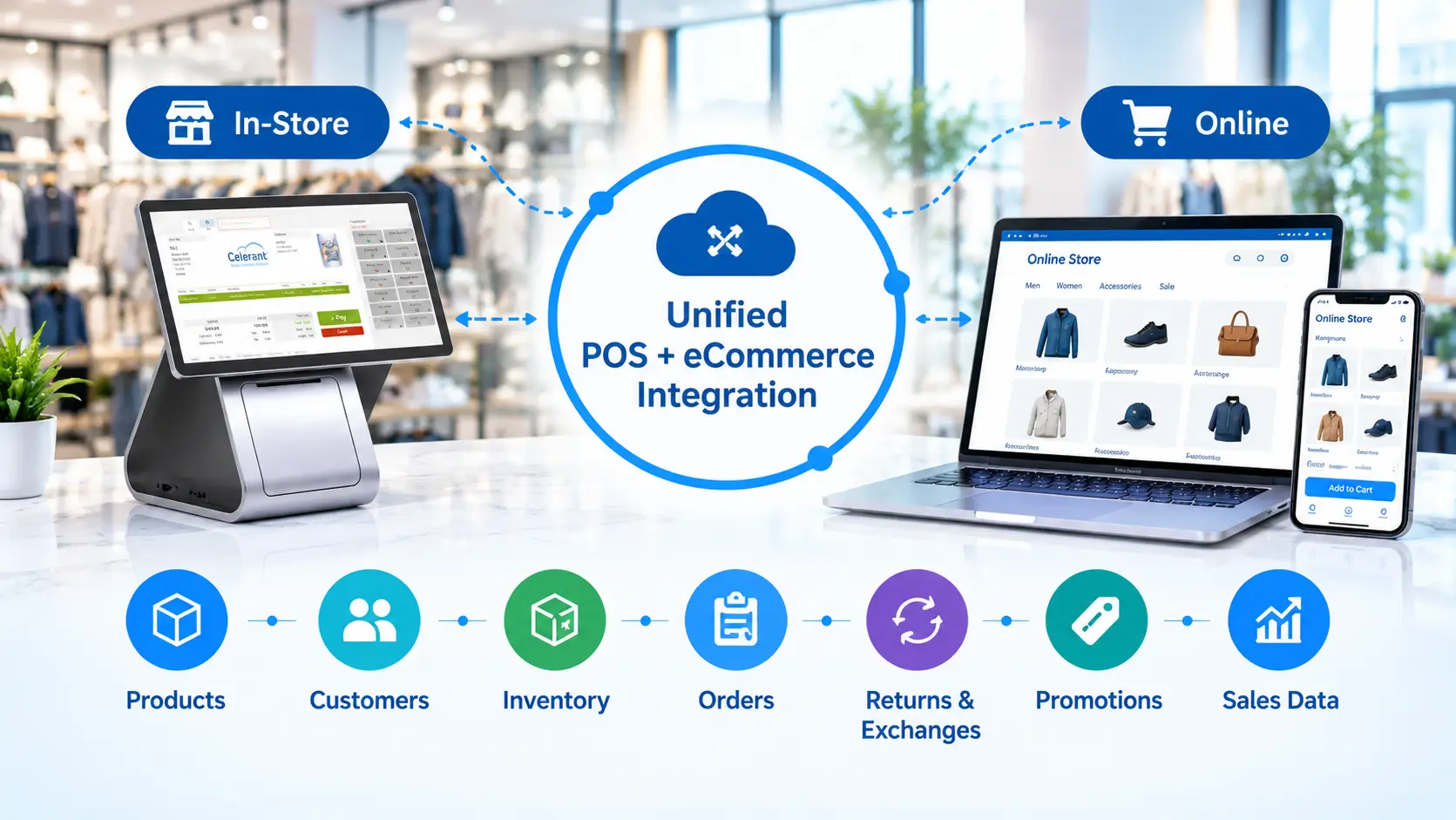
POS and eCommerce integration means that a retailer’s physical point-of-sale system is connected with its online store. This helps to move important information between channels. This integration enables retailers to synchronize products, customers, inventory, returns/exchanges, promotional offers, and sales data.
The goal is to create a connected retail operation where employees have access to consistent information whether a customer shops online or in-store. For example, whenever a customer buys an item in-store, the inventory must be updated accordingly. Likewise, an online order needs to be reflected in the order management process alongside the retailer’s inventory.
POS and eCommerce integration fails when both systems don’t have synchronized data. Most of the time, the data synchronization is delayed, and multiple third-party connections lead to errors. Here are seven of the most common reasons why POS and eCommerce integration breaks in retail:
One of the main challenges for most retailers is to connect platforms that organize data in a different structure. For example, a POS system identifies products with SKUs, whereas an eCommerce platform may use product IDs, variant IDs, and other identifiers. The product categories, pricing, attributes, and inventory locations all use different formats.
When these fields aren’t mapped correctly, data can fail to transfer between systems. This leads to duplicate products, inaccurate inventory counts, and pricing gaps.
Accurate inventory is crucial for omnichannel retail. Consider a retailer with one item left in stock. If that item is sold in-store but the online inventory isn’t updated, the product could remain available for customers to purchase on the website.
The situation becomes difficult to manage, particularly for retailers running multiple stores, eCommerce sites, warehouses, and marketplaces. Without timely stock updates, employees may see inaccurate inventory information, making it difficult for retailers to understand where products are actually available.
Retailers must consistently update their product information, including price changes, new products, descriptions, and product variants such as sizes and colors. When product information isn’t synchronized between POS and eCommerce systems, gaps arise. Customers see one price and product details online and different information for the same product in-store. Centralizing product information can reduce duplicate data entry and help maintain consistency across channels.
POS and eCommerce integration needs to support more than the initial sale. For example, a customer purchases a product online and returns it through a physical store. When systems aren’t connected, employees may need to handle these processes manually, increasing processing time and the risk of errors. The same process applies to product exchanges, cancellations, and refunds. When there isn’t a connected system, employees execute processes manually, increasing total processing time and risk of errors.
Retailers rarely rely on a POS and eCommerce platform. They also use accounting software, CRM, payment providers, marketplaces, loyalty programs, and warehouse management systems. Every system generates and exchanges data. When these systems aren’t connected, data can become delayed, duplicated, or transferred inaccurately.
This is why retailers must have a broader perspective of the entire technological ecosystem to work as a whole rather than focusing on the POS and eCommerce integration.
When systems aren’t automated, employees often become the link between them. They have to export spreadsheets, update inventory manually, enter customer information again, and check multiple platforms before order processing.
These manual workarounds become increasingly inefficient as transaction volumes grow, creating more room for missed updates and data entry errors.
Even a well-designed integration can have problems. An API connection can temporarily fail, a product record can contain invalid information, and synchronized processes can stop unexpectedly.
Without the appropriate error notifications and monitoring, retailers aren’t aware of any issue until an inventory discrepancy occurs or a customer reports a problem. Retailers must consider integration monitoring and error handling when checking any technology.

Poor integration affects retail operations, such as:
These issues become even more complicated for multi-location retailers as inventory and transactions are distributed across multiple locations.
Retailers must identify the data that needs synchronization, such as inventory, product pricing, customers, orders, and store locations. They need to evaluate if technology can support omnichannel workflows including:
Testing these scenarios helps identify data mapping and workflow problems beforehand. Retailers also need to monitor integrations once the implementation is done. When product catalogs, transaction volumes, and business needs evolve, integration also needs adjustment for reliable performance.

Why does my POS inventory not match my eCommerce inventory?
POS and eCommerce inventory can become inconsistent when data synchronization is delayed, product information is mapped incorrectly, transactions fail to sync, or an integration experiences an error.
Can a POS system integrate with an eCommerce platform?
Yes. Many modern POS systems integrate with eCommerce platforms to synchronize inventory, products, orders, and customer data. However, the available features and synchronization capabilities vary by platform and integration architecture.
How do I keep POS and eCommerce inventory in sync?
Integration provides better inventory visibility, reduces manual data entry, connects online and in-store orders, supports omnichannel fulfillment, and helps maintain consistent product information.
What is the difference between POS integration and unified commerce?
POS integration only connects a POS solution with another platform, for example, an eCommerce site. Unified commerce connects all the key retail operations and touchpoints through a centralized system.
How can multi-location retailers manage POS and eCommerce inventory?
Multi-location retailers use centralized inventory management to maintain visibility across warehouses, online channels, and physical stores. The solution should provide real-time inventory updates and location-level stock visibility.
Retailers need to think beyond whether the two platforms can technically connect. They must ensure that the technology can scale with their business plans and growth.
This means that the system they incorporate must offer inventory synchronization in real time, centralize product pricing data, and share visibility across the multi-store inventory. It must also connect online and in-store orders from marketplaces, offer scalability for omnichannel retail, and monitor integration and error handling.
A unified retail solution like Celerant is how retailers can simplify the entire process and connect their core retail operations instead of multiple disconnected systems. It brings POS, eCommerce, inventory, and other core retail operations into a connected environment. This also reduces operational complexity that can arise from managing data across separate platforms.
Real-life customer case studies, including BC Surf and Sport and Trinkets Boutique, show how retailers have integrated Celerant’s unified retail solution to connect multiple physical stores and eCommerce websites, while gaining better visibility into inventory, sales, and reporting. These examples indicate how connected retail systems can help businesses manage multiple locations and sales channels effectively.