Blog
Growing Sporting Goods Retail Sales with an All-in-One Point of Sale System
April 24, 2026 / 9 minute read / By Nick Borowitz
Sporting Goods
Blog
Between aggressive pricing from big-box retailers and the convenience of online marketplaces, sporting goods retailers are under constant pressure to do more with less. The playing field isn’t level—and it’s not getting easier.
What they can’t replicate is local expertise. The staff member who knows how to fit the right gear. The shop that’s been tuning bikes for years. The relationships built by outfitting local teams season after season. That’s your edge—but only if your operations don’t get in the way.
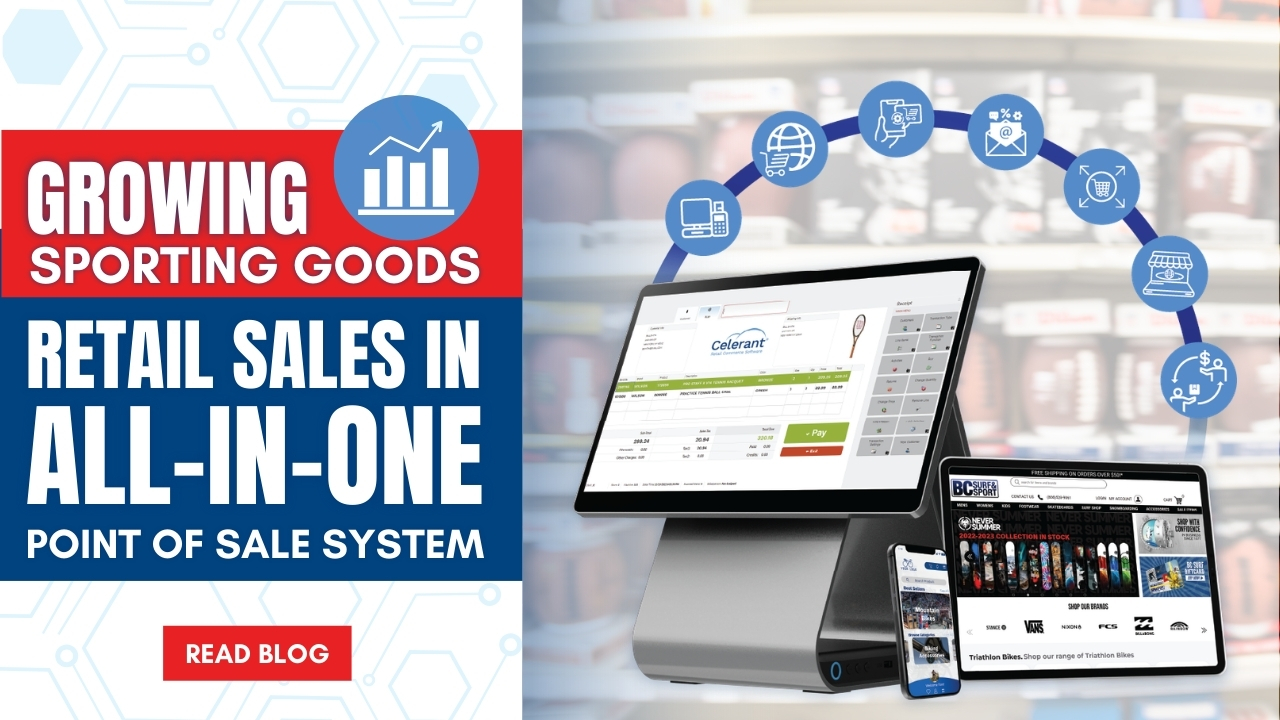
The difference between struggling and growing often comes down to one thing: technology. Not a mix of disconnected tools—but a single, unified POS system built to handle the complexity of sporting goods retail.
Let’s jump in.
Before exploring specific capabilities, it’s important to understand why system architecture matters. In a sporting goods business, your POS should function like a central nervous system—connecting every part of your operation and keeping data flowing in real time.
Many retailers start with separate tools: point of sale, eCommerce, inventory spreadsheets, email marketing tools, and more. When systems don’t communicate in real time, data falls out of sync.
An all-in-one platform eliminates these friction points by creating a single source of truth—ensuring every part of the business stays aligned. With a connected system, you can make better decisions about purchasing, staffing, and marketing. You can expand to new locations or channels without overhauling your tech stack, and rely on a single support team instead of juggling multiple vendors.
That level of coordination is what allows a sporting goods retailer to operate—and grow—like a much larger business.
Inventory is the heartbeat of any retail business—and in sporting goods, it’s especially complex. A single category can include multiple sizes, widths, colors, and styles. Add team uniforms, equipment, accessories, and seasonal demand, and inventory quickly becomes one of the most resource-intensive parts of the business.
The right retail technology turns that complexity into an advantage. The table below highlights the key inventory capabilities sporting goods retailers need in a modern POS system—and the growth impact each delivers.
| Inventory Capability | What It Solves | Growth Impact |
|---|---|---|
| 3D Product Matrix | Manages size, color & width variations without manual workarounds | Fewer errors, faster checkout, accurate orders |
| Serialized Item Tracking | Tracks high-value items (bikes, firearms, specialty gear) individually | Ensures compliance, simplifies warranties, builds trust |
| Min/Max Auto-Replenishment | Prevents stockouts on fast-moving items | Keeps best-sellers in stock, reduces overbuying |
| Handheld Scanner Inventory | Eliminates need to shut down for full inventory counts | Enables cycle counts while selling, maintains accuracy |
| Catalog Imports from Distributors | Removes manual SKU entry across large product catalogs | Speeds onboarding, improves product data & online experience |
Fulfillment Options That Drive Revenue
Fulfillment is where omnichannel becomes real. The options you offer directly impact conversion, convenience, and customer satisfaction.
Each method depends on accurate, real-time inventory. Offer BOPIS without live sync, and you risk disappointing customers. Enable drop ship without vendor feeds, and you risk overselling. Fulfillment and inventory are tightly connected—and both need to run on a single platform to work reliably.
| Fulfillment Method | Customer Benefit | Tech Requirement | Competitive Edge |
|---|---|---|---|
| BOPIS (Buy Online, Pick Up In-Store) | No shipping, no wait—same-day pickup | Real-time inventory sync + pickup workflow | Drives foot traffic & add-on sales |
| Curbside Pickup | Fast, convenient, no need to enter store | Order alerts, staging, POS order management | Appeals to busy local shoppers |
| Same-Day Local Delivery | Get products same day without visiting store | Delivery integration or driver dispatch tools | Competes with Amazon & big-box delivery |
| Drop Ship from Distributor | Access to more products without store limits | Live vendor inventory feed integration | Expands catalog without added inventory |
| Marketplace Fulfillment (Amazon, eBay, Walmart) | Shop on familiar platforms | Marketplace sync + centralized order management | New revenue channels & wider reach |
Online Marketplaces and Social Commerce
Beyond your own website, marketplaces and social platforms open additional revenue channels. Each attracts a different type of shopper, so the right mix depends on your products and audience.
Managing multiple channels only works with tight integration. When all channels pull from the same inventory managed by your POS, stock updates automatically and orders flow into one system. That’s what makes omnichannel selling scalable without adding operational complexity.

One of the most valuable capabilities of a modern retail platform is the ability to integrate with distributors and vendors. For sporting goods retailers, this enables the “endless aisle”—the ability to offer a much larger product catalog than what’s physically in-store.
In practice, the POS system connects to a distributor and pulls in their live product catalog. Retailers can display those products online or through in-store kiosks without carrying the inventory.
When a customer places an order, it’s automatically routed to the distributor for fulfillment. The retailer captures the sale, the vendor ships the product, and the customer gets what they need—without the store holding excess stock.
This is especially valuable in sporting goods, where products come in countless variations. No small shop can stock every size, style, or configuration. Vendor integrations allow retailers to offer a full catalog and capture sales that would otherwise go to big-box competitors.
There’s also a relationship advantage. Retailers using integrated ordering and electronic purchase orders build more transparent partnerships with distributors—often leading to better terms, priority access to high-demand products, and stronger collaboration on promotions.
One of the most durable advantages independent sporting goods retailers have is the ability to offer specialized, local services.
These services drive recurring revenue, strengthen customer relationships, and build long-term loyalty. The challenge isn’t offering them—it’s managing them efficiently. Without the right system, work orders get lost, team orders become chaotic, and rental equipment goes untracked.
This is where the POS system becomes critical.
Repair and Service Management
Repair and maintenance services provide steady revenue, even when product sales fluctuate. A modern POS system allows staff to create work orders tied to customer profiles, track parts used from inventory, schedule completion dates, and automatically notify customers when items are ready.
Service history also becomes a marketing tool. A past bike tune-up or ski check can trigger timely, relevant follow-ups—turning routine service into repeat business.
Team Sales and Custom Merchandise
Team sales are high-value but complex. Managing league orders, custom gear, and multiple buyers can quickly become overwhelming without the right system.
An advanced platform simplifies this by enabling detailed team orders, managing embroidery and customization in one workflow, and offering online player pack stores where individuals can select their own items.
This reduces coordination and creates a smoother experience for both the retailer and the customer.
Rentals, Memberships, and Recurring Revenue
Rental programs create consistent revenue and introduce customers to new products. Managing rentals within the POS system keeps inventory tracked and operations organized.
Membership programs build on this by creating predictable revenue and deeper customer engagement. Whether offering discounts, early access, or included services, memberships can be managed directly in the system—with benefits automatically applied at checkout.
Related: How to Open a Bike Shop?
For sporting goods retailers, a strong loyalty program is one of the highest-impact ways to drive repeat business.
The most effective programs go beyond simple points-per-dollar. They reward key behaviors—purchases, referrals, reviews, event participation, and service engagement—each contributing to long-term customer value.
Delivery matters just as much. Mobile apps allow customers to track points, view rewards, and receive personalized offers. Push notifications deliver timely promotions without getting lost in email.
When loyalty is connected to the POS, every purchase—online or in-store—feeds into the same reward system, creating a consistent experience across channels.
Personalization is what makes it work. A customer buying cycling gear should get cycling offers. A seasonal ski shopper should get timely winter promotions. When loyalty ties into POS and eCommerce data, marketing becomes targeted, relevant, and far more effective.
Growing a sporting goods retail business takes more than product knowledge and passion—it requires the operational infrastructure to scale.
An all-in-one POS system isn’t just for transactions. It’s the central nervous system of the business—the system that connects everything and enables growth.
When inventory is accurate, marketing performs better. When vendor integrations are live, your catalog expands without added overhead. When loyalty connects across channels, customers get a consistent experience no matter how they shop.
Retailers who invest in the right technology foundation are better positioned to compete with larger players while building a business rooted in local expertise and relationships. It’s what allows your real differentiator—your people—to focus on what they do best.
Related: Take our short retail software quiz
If you’re looking to simplify operations and support growth, it starts with the right system.
Celerant’s sporting goods POS platform is built to handle the complexity of your business—from inventory and vendor integrations to team sales, services, and loyalty. Instead of managing disconnected tools, you run everything from a single, unified system.
That means real-time inventory across all channels, expanded product access through vendor integrations, streamlined service management, and a consistent customer experience from first interaction to repeat purchase.
Explore how Celerant can help you operate more efficiently, scale with confidence, and focus on what sets your business apart.


 2024
2024