Blog
The Safest Buying Strategy Could Be Putting Your Retail Business at Risk
September 15, 2026 / 10+ minute read / By Zoya Naeem
General, Inventory Management


Blog
Every retailer wants to make good buying decisions. The problem is that retail rarely gives you enough certainty to know whether a decision will be good until you have already made it. You can study last year’s sales, look at current demand, watch what competitors are doing and build the most carefully considered buying plan possible, then have a change in weather, a supplier delay or a shift in customer demand throw the whole thing sideways.
That makes risk an unavoidable part of merchandise planning.
The question is not whether you can eliminate it, because you cannot. The more useful question is where you are prepared to take it, how much you can afford to take, and whether you are making that decision from evidence or simply hoping your instincts are right.
That was one of the central ideas we explored during our August webinar, Managing Risk: How Top Retailers Buy Smarter and Protect Profit, featuring Michele Salerno from Celerant, Jeff Sward from Merchandising Metrics, and Jeff Dillon and Dmitry Goykhman from ANT USA. The discussion covered everything from inventory and assortment risk to supply chain uncertainty, seasonality, technology, and the role of Open-to-Buy planning.
But there was a bigger idea running through the conversation.
Risk is not automatically a bad thing in retail. Managed properly, it can become part of your competitive strategy.
Retailers deal with risk long before a product reaches the shelf.
There is the obvious inventory risk. Buy too much and you tie up cash in stock that may eventually need to be marked down. Buy too little and you can run out just when customers are ready to buy.
Then there are the risks that sit outside the buying decision itself. A supplier misses a shipment. A product arrives late. Weather changes demand. A competitor launches something unexpected. A website goes down. Costs increase. A product suddenly stops performing the way it did last season.
Some of these risks can be anticipated. Others cannot.
And that distinction changes how you should plan for them.
Historical data gives retailers a useful starting point.
If a product sells consistently every year, if a category follows a reliable seasonal pattern, or if you know how much stock you typically need to support a certain level of demand, those patterns can help you make a more informed decision.
This is where structured merchandise planning becomes valuable.
A good Open-to-Buy planning process gives retailers a way to look ahead at expected sales, inventory levels, purchasing commitments and available budget instead of making every buying decision in isolation.
But history has limits.
The fact that something happened last year does not mean it will happen again this year. Retailers still have to make decisions around the things they cannot see coming.
That is where risk gets more interesting.
You have the knowns. You have the things you can reasonably predict. Then you have the unknowns that force you to leave yourself room to adjust.
The smartest buying strategy has to account for all three.

One of the most useful ideas from the webinar was that risk should not be treated as a simple yes-or-no decision.
A product is not simply “risky” or “safe.”
There are degrees of risk.
A core product with steady demand and reliable replenishment might require a very different commitment from a new product with no sales history, a long lead time and an uncertain customer response.
That sounds obvious, but it becomes harder when you are managing hundreds or thousands of products across categories, vendors, locations and seasons.
This is where retailers need to start thinking about their merchandise as a portfolio.
Some products provide stability. Others create opportunities for growth. Some are highly predictable. Others are more speculative. Some can be replenished quickly if demand is stronger than expected. Others require a significant commitment months before customers have even had a chance to respond.
The goal is to understand the risk attached to each decision and make your commitments accordingly.
There is an understandable instinct in retail to protect the business from mistakes.
Nobody wants excess inventory sitting in a warehouse. Nobody wants to explain a bad buying decision to the finance team. Nobody wants to commit too much money to a product that does not sell.
But there is another side to that decision.
If you consistently avoid anything uncertain, you can also end up avoiding the opportunities that could help your business stand apart.
Retailers need products that customers already know and trust. They also need reasons for customers to choose them over the store down the street, the marketplace online or the retailer with a bigger advertising budget.
That can mean taking a calculated chance on a new product, a different assortment, a new category or a larger commitment where the potential return justifies the exposure.
As Jeff Sward put it during the webinar, retailers should think about building a portfolio of products and balancing different layers of risk rather than treating every buying decision the same way.
That is a much more useful way to think about merchandise planning.
There is a temptation in modern retail to believe that better data will eventually remove uncertainty from buying.
It will not.
Better data can tell you what happened, what is happening and, when used properly, what is more likely to happen next. It can highlight patterns that would be difficult to spot manually and give your buying team a much stronger foundation for making decisions.
But someone still has to decide what to do with that information.
A retailer might have strong historical sales data for a category but still decide to change the assortment because customer preferences are shifting. A buyer might see an opportunity that does not have a perfect historical precedent. A merchant might decide that the potential upside justifies the risk.
That is retail.
The important thing is making those decisions with as much information as possible and understanding what you are committing before you make the call.
Our guide to Mastering Open-to-Buy Strategies explores this balance in more detail, including how retailers can use OTB to assess risk, time purchases and make inventory commitments with greater visibility.
Open-to-Buy (OTB) is more than a budgeting exercise.
OTB gives retailers a framework for deciding where their available buying budget should go and how much flexibility they need to keep.
It helps answer questions such as:
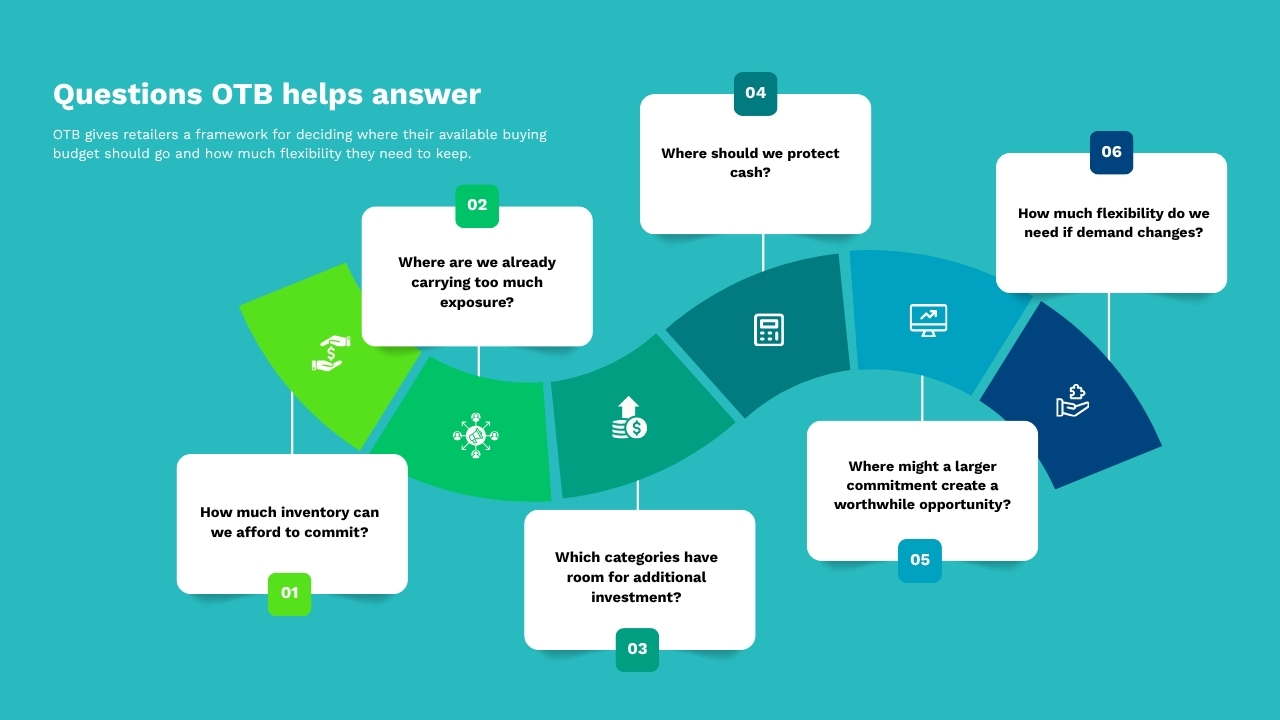
Those questions become particularly important when products have different levels of uncertainty.
A predictable replenishment item and a new seasonal product should not necessarily receive the same treatment. A product with a six-month lead time requires a different commitment from one that can be replenished locally within days.
The more complex the assortment becomes, the more important that visibility becomes.
This is why we have argued before that merchandise planning is a continuous process, not a set-it-and-forget-it exercise. Sales performance, inventory position, and expectations change throughout the season, so the plan has to be capable of changing with them.
They are deciding where to take it.
That requires knowing which products are predictable, where uncertainty is higher, how much capital the business can expose, and when buyers need flexibility to respond to changing demand. Historical performance should inform the plan without dictating it, while an active OTB process helps retailers make deliberate commitments instead of reacting to problems after they appear.
Some calculated risks will fail. The bigger problem is taking risks without understanding the exposure.
You cannot control the weather, customer behavior, supplier delays or every change in the market.
You can control how much visibility your team has when it is time to make a decision.
Accurate sales data, reliable inventory numbers, clear purchasing commitments and a structured OTB process give retailers a much stronger foundation for deciding where to spend, where to hold back and where to take a calculated chance.
That is also why strong inventory management matters far beyond simply knowing what is on the shelf. When inventory, sales and planning data work together, retailers have a clearer view of what is happening across the business and can adjust before a small issue becomes an expensive one.
The goal is to make better decisions with the information you have today and give yourself enough flexibility to respond when tomorrow looks different.
It starts with accepting that risk is not something retailers can eliminate. It is something they need to understand, measure and manage.
Retailers need to know where they are comfortable taking risk and where they are not.
Buying teams should be able to explain why they made a particular commitment instead of relying on “it felt right.”
OTB should support active planning rather than serve as a number that gets checked once a month.
The plan should also leave enough flexibility to take advantage of new opportunities when they appear.
Risk is not going away. The retailers that manage it best are not necessarily the ones taking the least risk. They are the ones that understand the risks they are taking, know what they can afford to lose, and have a plan for what happens next.
We dug into these ideas in our latest OTB webinar, Managing Risk: How Top Retailers Buy Smarter and Protect Profit, with Celerant, ANT USA and Merchandising Metrics.
Watch the full session to hear the panel discuss inventory risk, assortment decisions, predictable and unpredictable risk, OTB planning and why taking the right risks can help retailers create meaningful differentiation.