Blog
From Inventory Chaos to Connected Retail: The Sporting Goods Technology Shift
November 26, 2026 / 10+ minute read / By Muneeza Shahid
Artificial Intelligence, Inventory Management, Point of Sale, Sporting Goods

Blog
Inventory management is one of the biggest operational challenges for sporting goods retailers. Unlike stores selling products with limited variations, sporting goods retailers manage extensive product catalogs spanning multiple brands, sizes, colors, models, and specifications. They must also account for seasonal demand, team orders, online sales, and supplier relationships while maintaining accurate inventory across every sales channel.
For example, a single running shoe model may be available in several colors and sizes, while a bicycle may require different components, accessories, and specifications. Add seasonal products, sporting equipment, and eCommerce orders to the mix, and coordinating inventory becomes even more complicated.
Sporting goods POS software and inventory management systems help retailers connect sales, purchasing, inventory, customer information, and eCommerce through a centralized platform. Instead of relying on disconnected applications and manual spreadsheet updates, retailers can gain better visibility into stock levels, streamline multi-store operations, and deliver a more consistent customer experience.
However, achieving connected retail starts with addressing one of the biggest operational challenges for sporting goods businesses: managing inventory across products, locations, and sales channels.
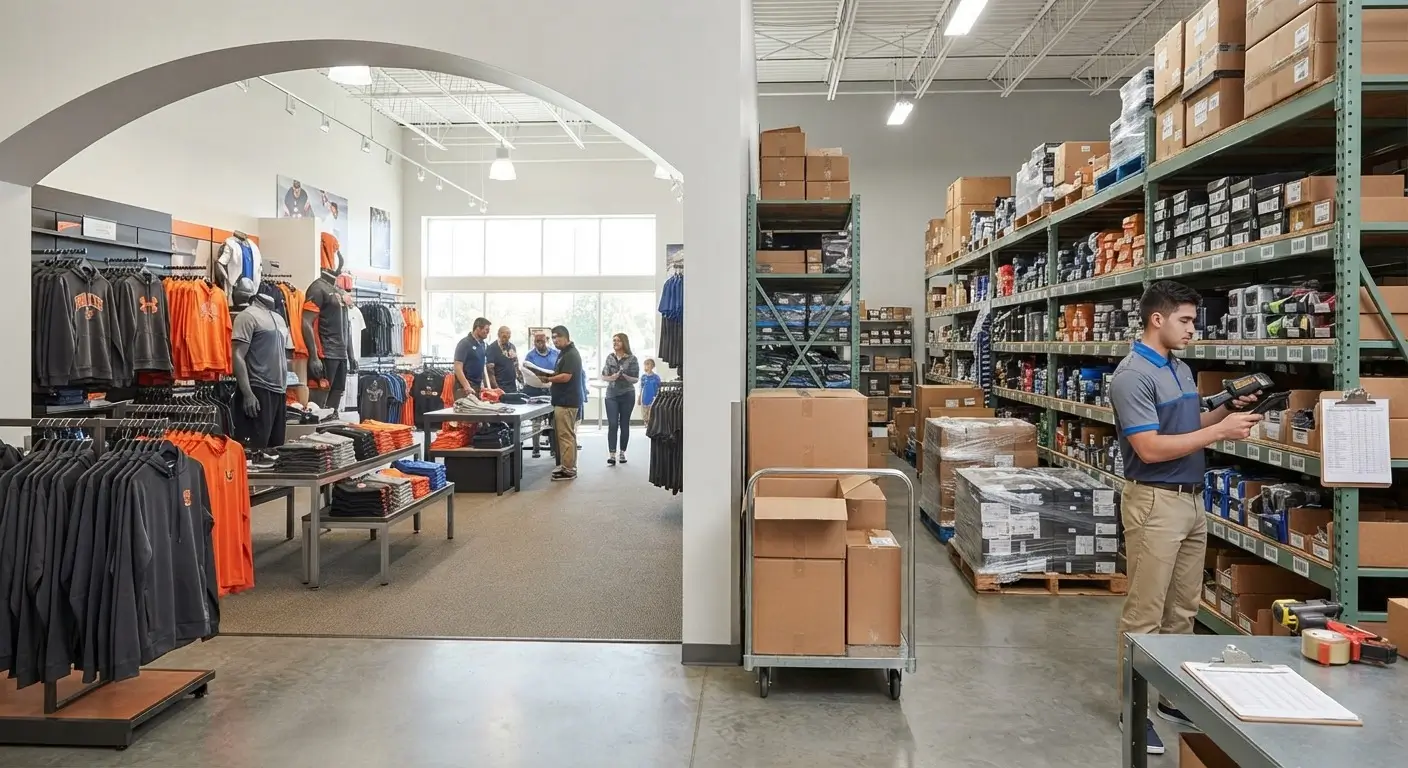
Sporting goods retailers operate in an environment where product availability, timing, and assortment directly influence purchasing decisions. Their extensive product catalogs include hundreds or thousands of SKUs based on brand, model, material, size, color, and other specifications. Managing these variations while maintaining accurate stock records makes inventory management particularly important.
A retailer may have 20 units of a particular shoe model in stock, but those units could be distributed across multiple sizes and colors. Employees need to know which variations are available, where products are located, and whether items have been sold, transferred, or reserved.
An inventory management system designed for sporting goods retailers can provide matrix inventory capabilities to organize products by attributes such as size, color, and style. This makes it easier to check product availability, process transactions, and identify items that need replenishment.
Demand for sporting goods changes throughout the year. For example, sales of bicycles, outdoor equipment, and camping gear often increase during warmer months, while winter sports equipment becomes more popular later in the year. Team uniforms and training equipment may also experience higher demand during school and sporting seasons.
Ordering too much inventory ties up working capital, while ordering too little can result in missed sales opportunities. Inventory software helps retailers review historical sales, current stock levels, supplier lead times, and purchasing information to make more informed buying decisions.
Many sporting goods retailers sell through multiple channels, including physical stores, eCommerce websites, and online marketplaces.
When inventory information isn’t updated consistently across these channels, customers may order products that are no longer available. This can lead to canceled orders, refunds, and a frustrating shopping experience.
Integrated retail systems help address this challenge by synchronizing inventory information across connected channels, reducing manual updates and improving stock visibility.
According to Deloitte’s 2025 Retail Industry Outlook, one-third of surveyed retail executives planned significant investments in accurate, real-time inventory visibility, a single view of customers across channels, and multiple fulfillment options. Deloitte also found that omnichannel shoppers spend 1.5 times more each month than single-channel shoppers. These findings highlight the importance of connecting retail operations to support customer convenience and business efficiency.
For multi-store retailers, accurate inventory visibility is particularly valuable when customers request products that aren’t available at their preferred location.
For example, if a customer visits a store looking for a specific bicycle helmet, employees can check stock at nearby locations, reserve the product, or arrange a transfer rather than losing the sale.
This helps retailers make better use of existing inventory while giving customers more purchasing options.
When POS and eCommerce systems share inventory and product information, retailers can maintain more consistent product availability across physical and digital channels.
This connectivity can support several fulfillment and sales workflows, including:
These capabilities help create a more convenient shopping experience while reducing manual administrative work.
Retail analytics allows sporting goods retailers to look beyond daily sales totals and understand how products perform across different locations and channels.
By analyzing product performance, sales trends, purchasing history, and inventory movement, retailers can identify:
These insights support more informed purchasing, replenishment, and inventory allocation decisions.
Traditional checkout counters can become bottlenecks during busy periods, particularly during seasonal promotions and team outfitting events.
Mobile POS allows employees to process transactions, check inventory, assist customers, and access product information from different areas of the store.
For sporting goods retailers, this can be particularly useful when customers need help comparing product specifications, checking available sizes, or placing special orders.
The result is a more flexible shopping experience where customer assistance isn’t limited to a fixed checkout counter.
While inventory management addresses product availability and stock accuracy, retailers also need a POS system that connects these processes with everyday sales and back-office operations.
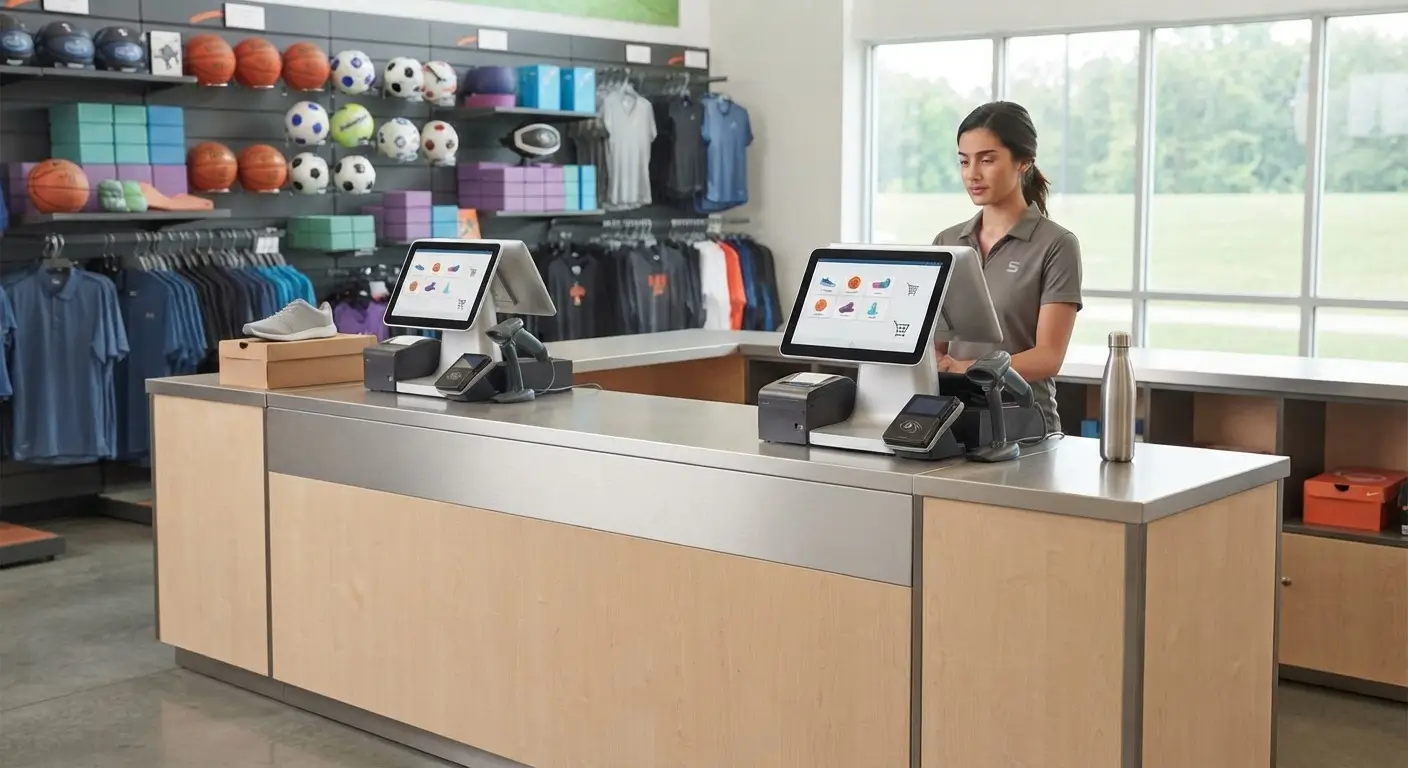
Sporting goods POS software is a retail management system designed to help sporting goods retailers manage sales, inventory, purchasing, customer information, and eCommerce operations through a centralized platform.
Unlike a basic checkout system, a specialized sporting goods POS connects front-end transactions with back-office operations, allowing retailers to manage more of their business through integrated software.
Common capabilities include:
The goal is to connect everyday retail activities rather than manage them through separate systems.
Beyond managing everyday transactions and inventory, sporting goods retailers can also use automation and AI-powered tools to analyze business data, anticipate demand, and make more informed purchasing decisions.
Artificial intelligence is becoming increasingly relevant to retail inventory management, purchasing, and business reporting. By analyzing historical sales, inventory information, and demand patterns, AI-powered tools can help retailers make more informed operational decisions.
According to Tata Consultancy Services’ (TCS) Global Retail Outlook: USA Key Findings, 50% of surveyed US retail executives identified inventory and demand forecasting as a priority AI initiative, while 48% prioritized supply chain optimization. These findings highlight the growing interest in using AI to improve inventory planning, anticipate demand fluctuations, and strengthen supply chain efficiency.
Demand forecasting helps retailers estimate future inventory requirements using historical sales trends, seasonal patterns, supplier lead times, and purchasing behavior.
For example, a sporting goods retailer can review previous sales of bicycles, camping equipment, or winter sports products to anticipate seasonal demand. Forecasting tools can help buyers identify potential inventory requirements and plan purchasing accordingly.
This supports better inventory planning while helping retailers avoid unnecessary stock investments.
Inventory automation can monitor stock levels and notify employees when products reach predefined reorder points.
Rather than manually reviewing hundreds or thousands of SKUs, purchasing teams can focus on products that require attention. Automated replenishment workflows can also help generate purchase orders based on minimum and maximum inventory levels.
This makes it easier to maintain product availability and reduce the risk of stockouts.
AI-powered reporting tools help retailers access and interpret business information more efficiently.
Managers can use these tools to identify:
These insights help retail teams make faster, more informed decisions. However, AI-generated recommendations should be reviewed alongside supplier constraints, local demand, and purchasing requirements.
While AI and automation can help retailers improve inventory planning and business reporting, these capabilities work best when supported by connected retail systems. Integrating POS, inventory management, purchasing, and eCommerce gives sporting goods retailers a centralized view of their operations.
Celerant provides sporting goods retail software designed to support independent retailers as well as more complex, multi-location businesses.
Key capabilities include:
Retailers can manage products, inventory quantities, pricing, and product variations through a centralized platform.
Celerant’s three-dimensional product matrix management supports products with attributes such as size, color, style, and model. This helps sporting goods retailers organize complex product catalogs and manage variations more efficiently.
Celerant supports vendor catalog integrations, purchase order creation, and replenishment workflows based on predefined inventory levels.
Retailers can access supported supplier catalogs directly within the POS system, import product information, and streamline purchasing. Automated ordering based on minimum and maximum stock levels can also help keep fast-selling products available.
Celerant connects POS and eCommerce operations, helping retailers manage products, inventory, and orders across multiple sales channels.
Supported distributor and marketplace integrations can also extend product availability, while endless-aisle capabilities allow retailers to offer additional products without necessarily holding all the inventory themselves.
Mobile POS functionality allows employees to assist customers and process transactions throughout the store.
Celerant also supports sporting goods-specific workflows, including team sales, customized merchandise, and special equipment orders. Retailers can manage products requiring embroidery and other embellishments through supported special-order capabilities.
Retail reporting tools help managers analyze sales, inventory, and product performance across their business.
Celerant has also introduced Skylar IQ, an AI-powered retail agent designed to help retailers access business information through natural-language questions. It can retrieve sales, inventory, customer, and operational data and present results through summaries, tables, and visualizations.
This can help retail teams access business insights without manually building complex reports. Its availability should be confirmed with Celerant before describing it as a generally available feature.

Sporting goods retail is becoming increasingly complex, with retailers managing diverse product catalogs, seasonal demand, supplier relationships, and multiple sales channels. Addressing these challenges requires more than standalone inventory tools or basic checkout systems.
By connecting POS, inventory management, purchasing, and eCommerce, retailers can improve stock visibility, coordinate operations across locations, and make more informed business decisions.
The shift toward connected retail isn’t just about improving individual processes. It’s about creating a more coordinated operation that supports both business efficiency and a consistent customer experience.
Want to see how integrated POS, inventory management, purchasing, and eCommerce can support your business?
What Is Sporting Goods POS Software?
Sporting goods POS software is a retail management system that connects sales, inventory, purchasing, customer management, and eCommerce operations within a centralized platform.
Why Do Sporting Goods Stores Need Inventory Management Software?
Inventory management software helps sporting goods retailers track product variations, manage replenishment, reduce stockout risks, and maintain accurate inventory across stores and online sales channels.
What Features Should Sporting Goods Retailers Look For?
Key features include matrix inventory management, multi-store inventory visibility, automated purchasing, eCommerce integration, retail reporting, customer management, and mobile POS functionality.


 2024